01 / Reproduce
Four empty scans, explained
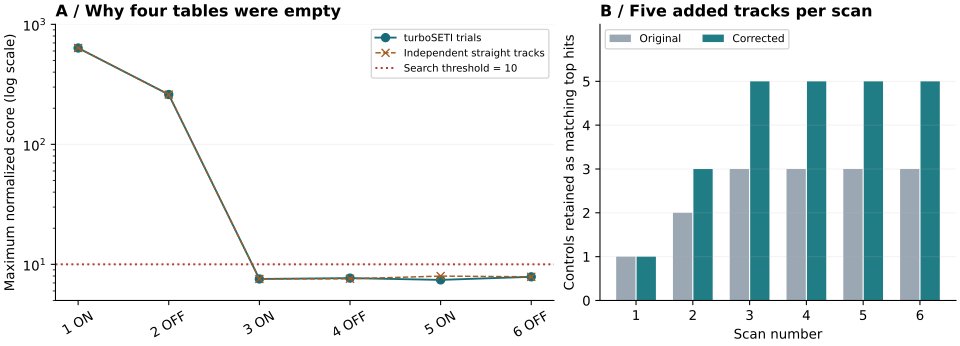
Both calculations stay below the search threshold. The corrected detector recovers all 20 artificial controls in those four scans.
Open science / A contribution you can inspect
Theoxenia independently processes public scientific recordings. Our contribution is the reproducible analysis: inputs, methods, checks, limitations and compact results.
The telescope recordings are real. The recovery controls are synthetic and labelled separately. Report 01 is published on Zenodo with its source snapshot and evidence. No scientific-team acceptance or external peer review is claimed.
Research report 01 / Real archive data / 18 October 2026
An empty table deserves an explanation. We replayed six telescope scans, checked the detector with independent calculations, and planted known signals in the measured backgrounds.
01 / Reproduce
Both calculations stay below the search threshold. The corrected detector recovers all 20 artificial controls in those four scans.
02 / Correct
A drift-coverage fix extends the tested boundary from ±3.827 to ±3.990 Hz/s. It adds one measured OFF-scan hit.
03 / Keep the limits
Six controls are lost during stronger-neighbor selection in crowded scans. This is a measured detector limit, not survey completeness.
| Scan | Pointing | Top hits | Detector max | Independent max | Controls |
|---|---|---|---|---|---|
| 1 · ON | HIP544 | 186 | 635.244 | 635.244 | 1 / 5 |
| 2 · OFF | HIP1024 | 150 | 260.186 | 259.875 | 3 / 5 |
| 3 · ON | HIP544 | 0 | 7.554 | 7.554 | 5 / 5 |
| 4 · OFF | HIP114 | 0 | 7.678 | 7.581 | 5 / 5 |
| 5 · ON | HIP544 | 0 | 7.421 | 7.983 | 5 / 5 |
| 6 · OFF | HIP1344 | 0 | 7.871 | 7.871 | 5 / 5 |
Published on Zenodo · DOI 10.5281/zenodo.23489303 · No external peer review. The original 273-row explorer is preserved; the corrected 336 per-scan hits are not a new clustered cadence table. Publication routes and metadata review.
01 / Preserve & cite
Publish a versioned analysis report, code snapshot and processed tables. Zenodo registers a DOI when a record is published. A DOI makes the work citable; it does not mean the scientific conclusion has passed peer review.
Zenodo record guidance ↗Report 01 published 20 October 2026 · Open the research record ↗.
02 / Contribute to the tools
Berkeley invites work on software and algorithms for its open data. A reproducible defect report, benchmark or tested patch can be useful even when an observation yields no surviving lines. Check each repository's current contribution rules.
Official open-data participation guide ↗No affiliation or endorsement is implied.
03 / Discuss a substantial result
Berkeley publishes a scientific-collaboration contact. Prepare a concise report with the exact observations, processing, checks and unresolved issues before approaching the team. This is a contact route, not an automatic validation service.
Official collaboration contact ↗No outreach or submission has been made.
A bounded questionState the observation, frequency window and method. Report the limits alongside the result.
A reproducible packageInclude the source identifiers, processing version, parameters, checksums and machine-readable results.
An honest statusKeep processing, internal review, external submission and external acceptance distinct. Link the actual record when a status changes.
Start small
Use a dossier to retrace the work, then share a concrete discrepancy or improvement through the project repository. Rerunning the historical recovery grid with the corrected detector and testing more cadences are useful next contributions.
Official destination guidance checked 18 October 2026. Participation pages may describe older programmes; verify the current route before sending work.